|
| Formula | Na(Mg,Fe,Li,Al)3Al6(Si6O18)(BO3)3(OH,F)4 |
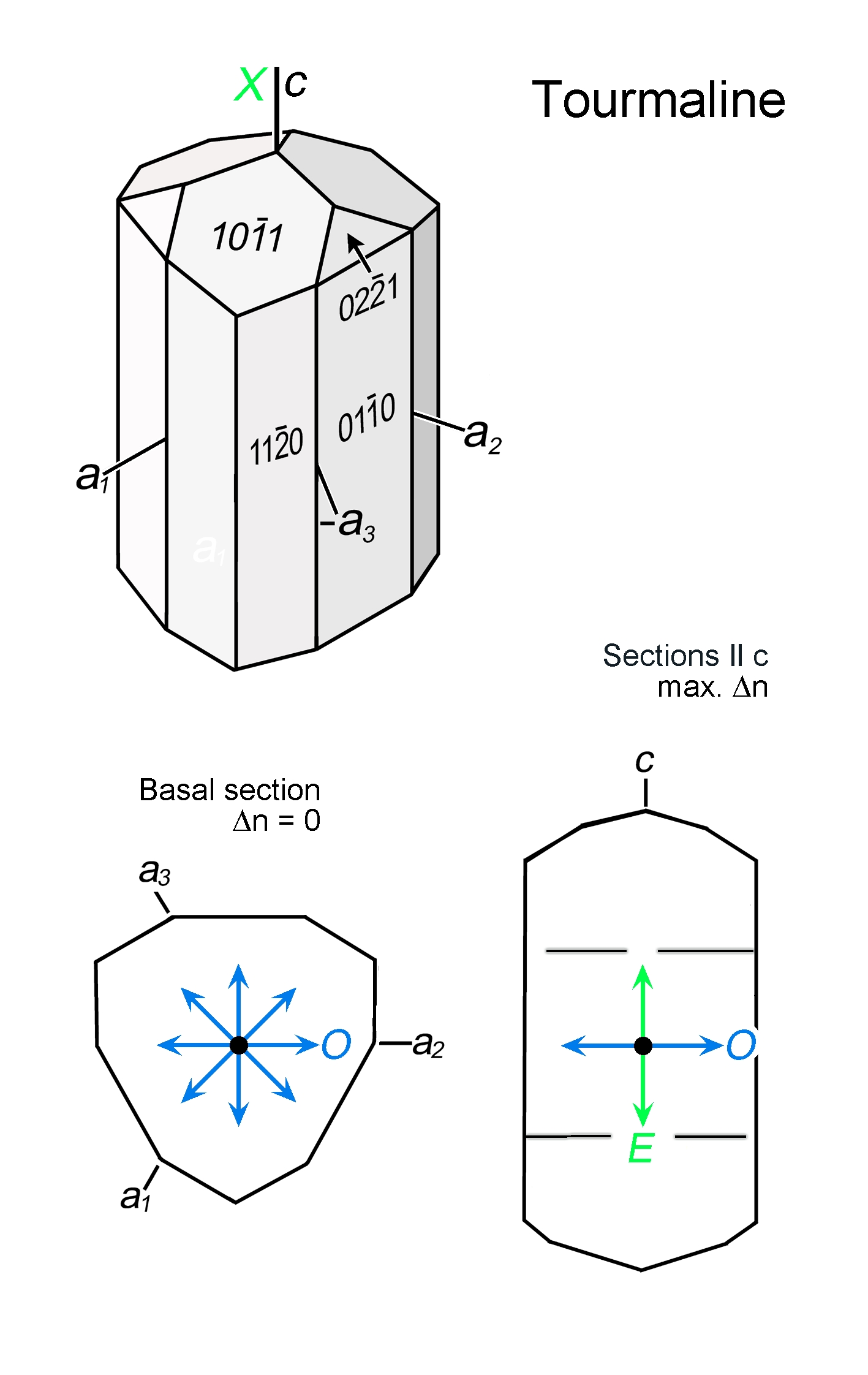
| | Optic class & sign | Uniaxial negative |
| | Relief | Moderate to high |
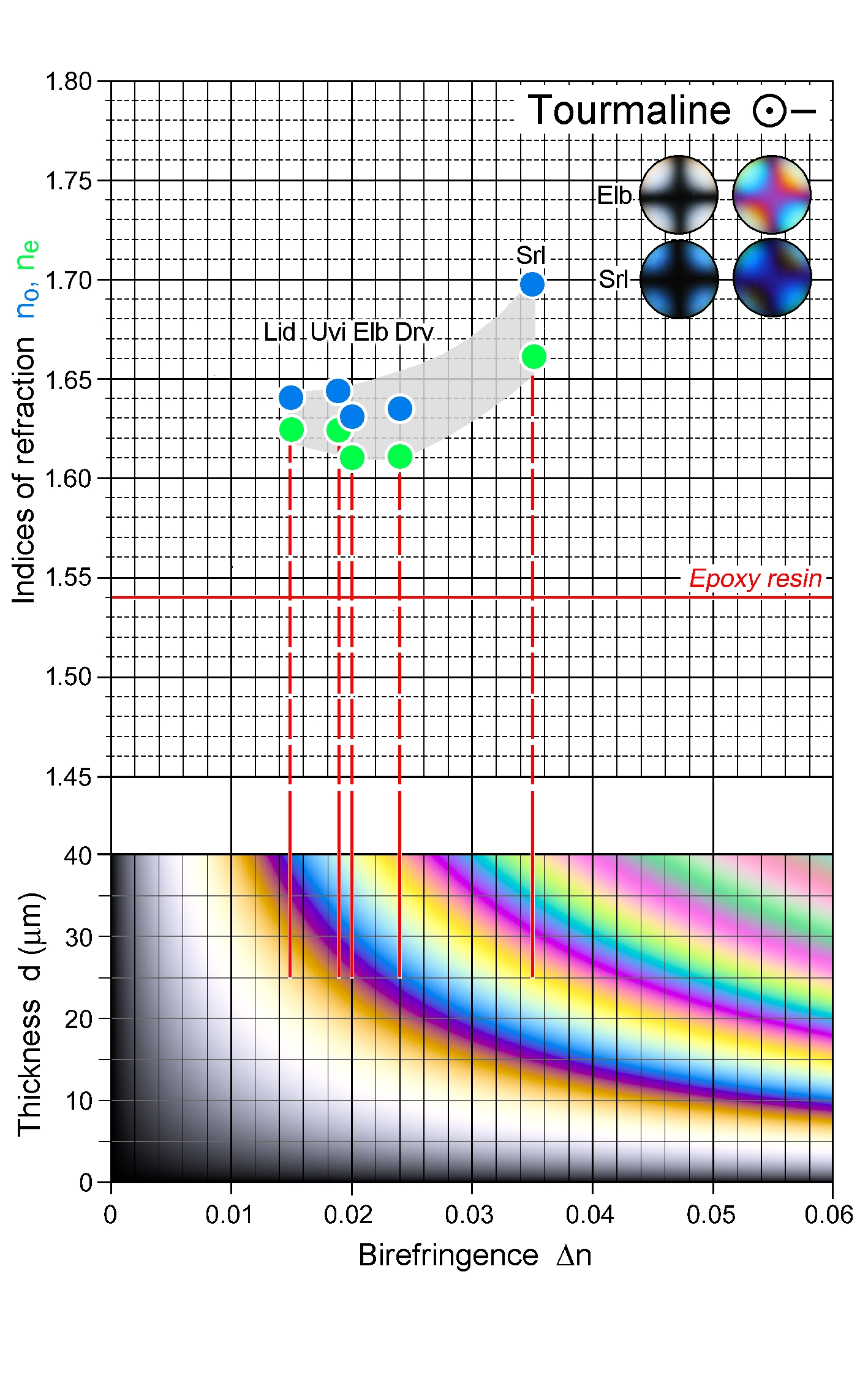
| | Refractive indices | no = 1.631 -1.698
|
|
ne = 1.610 -1.675
|
|
| Increase of n with increasing Fe, Mn, Ti; Fe3+-rich varieties may have an no as high as 1.8 |
| | Birefringence (max.) | 0.015 - 0.035 |
| | | Increase of Δn with increasing Fe, Mn, Ti; Fe3+-rich varieties may have Δn values up to 0.110; interference colours may be masked by mineral colour |
| | Sign of elongation | Length-fast, l (-) |
| | Interference figure | Weakly coloured varieties provide well-defined isogyres and first- to second-order isochromes; masking of isochrome colours in strongly coloured varieties. Minor isogyre separation up to 10° may occur. |
| | Colour / pleochroism | Colourless to strongly coloured, with highly variable colours; colour zoning is common. Coloured varieties display strong pleochroism with O>E (hence, basal sections show darker colour); Schorl may be green, blue, gray, or pink; elbaite: colourless to light-coloured; dravite-rich varieties: light brown, yellow, or colourless; colour intensity increases with Fe content. Absorption in O direction may be extreme such that crystals appear black. |
| | Zoning | |
|
|
| Form | Habit | Stubby to acicular, elongate in c direction; also radiating aggregates; basal sections of simple crystals may be six-sided-trigonal; otherwise, multiple prism faces give the basal sections a characteristic triangular shape with "outward bulging" sides |
| | | Surface | Typically euhedral to subhedral |
| | Cleavage | {1120}, {1011} very poor, fractures roughly orthogonal to c |
| | Twinning | Rare |
| | Extinction | Straight to prism faces in sections ∥ c |
|
|
| Reaction textures | |
| | Alteration / decomposition | Sericite, chlorite, lepidolite; relatively resistant to weathering |
|
|
| Occurence | Ign | Granite, granodiorite, pegmatite |
| | | Met | Rocks affected by boron metasomatism; common accessory mineral in metapelites; meta-evaporites derived from borate-rich deposits |
| | | Sed | Detrital in sands (heavy mineral fraction) |
| | | Hyd | Veins, tourmaline-quartz rocks (products of "tourmalinization") |
| | | Other | |
|
|
| Distinctive properties | Strong pleochroism if coloured, upper-first to second-order interference colours, characteristic basal sections, lack of cleavage, maximum absorption orthogonal to c axis. Small grains of colourless anhedral tourmaline may be most easily overlooked. |
| | Additional comments | |
|
|

 Images